Technical note · September 2026
Why not to time a positively skewed book
The return is earned in a handful of months. You cannot mark them on a calendar in advance.
A positively skewed book makes most of its money in a few large plus months and spends the rest of the calendar in small losses or quiet gains. That shape is mechanically uncomfortable. The typical month is forgettable. The months that matter are rare and not scheduled. An allocator who waits for a “better entry,” or who redeems after a dull stretch, is cutting the right tail — which is the product.
Capital Fund Management made the same point with trend-following indices: convexity produces a fat right tail; the accelerations are not forecastable; the cost of timing is missing them (CFM, Making fat right tails fatter with trend following — most of the time, Technical Note, November 2018). This note reprints that argument on listed vehicles anyone can download, so the tables are not a private book.
What the public sleeve looks like
Equal-weight, each month, of the managed-futures ETFs that are alive that month among WTMF, FMF, DBMF, KMLM, and CTA (at least two names). Monthly total returns, September 2013–August 2026, n = 156. Cash stand-in is BIL. Source: Yahoo Finance, adjusted closes, month-end.
| Book | Monthly mean | Monthly median | Skew | Hit rate | Cumulative | 5 best / sum |
|---|---|---|---|---|---|---|
| Stay in the sleeve | +0.30% | +0.39% | +0.13 | 58% | +54.7% | 58% |
| Same sleeve, drop the 5 best months | +0.13% | +0.21% | −0.37 | 55% | +18.8% | — |
| Same sleeve, drop the 10 best months | +0.00% | +0.06% | −0.63 | 52% | −1.7% | — |
| SPY, same window | +1.22% | +1.78% | −0.39 | 70% | +484.5% | 28% |
The sleeve is not a hero book. CAGR is about 3.4%. That is the point. Even a modest, listed, fee-embedded trend sleeve has a tail-carried mean: five months are 58% of the arithmetic sum; ten months are the thirteen-year profit. SPY, over the same window, is the other shape — negatively skewed, profit spread much more evenly (top five months = 28% of the sum). You can be late to equities and still own a lot of the return. You cannot be late to the sleeve.
One named fund, for a second look: KMLM, January 2021–August 2026 (n = 68). Monthly mean +0.54%, median +0.21%, hit rate 53%. The five best months are 109% of the sum of all months — the rest of the sample nets negative. Remove those five and the cumulative return flips from +38% to −6%.
Why a timer fails here
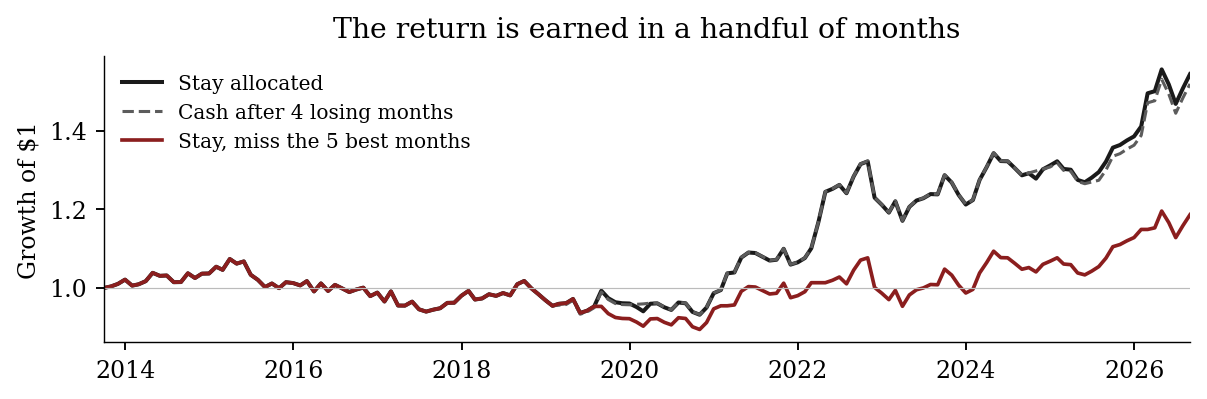
The five months that carry the sleeve are not a cycle you can mark on a calendar in advance. They cluster when the underlying trends are already underway (the 2022 block is visible on the chart). By the time a trailing-loss rule, a “wait for confirmation,” or a performance-committee pause has fired, those months are often already in the rear-view. CFM’s language is exact: investors trend-follow the performance of the positively skewed book, redeem in the left mass, and re-enter after the right tail has printed.
A losing-streak rule is the wrong enemy. On this sleeve it is in cash only 8% of months and cuts the cumulative return from +55% to +52%. Boredom is cheap. Absence during the five best months is not: the same stay-put book falls from +55% to +19%. Miss ten months and you have donated the entire sample.
That is the allocation rule. If the mandate is a positively skewed, tail-carried book, the size is set once, as a core sleeve, small enough that a dull year is tolerable. It is not turned on and off because last quarter was quiet. Timing the book is not a second strategy. It is a way to own the median month and give away the mean.
Sleeve construction is public and mechanical (equal weight of listed tickers). It is not a live program, not a backtest of an internal engine, and not a claim about capacity or fees beyond what the ETFs already charge. Past returns do not forecast the next right-tail month — that is the argument. © 2026 Scott Mandel / Pathwise.